The easiest gluten free cookies are those with no cereal flour: almond cookies, with just ground almonds, sugar and egg, and oat and banana cookies, as long as the oats are certified gluten free. Here are both recipes, a chocolate chip variant, the most common mistakes and what to check on the label.
For more sweet ideas, see gluten free desserts, gluten free churros and gluten free recipes.
Updated on 22 November 2026.
Short answer: cookies are gluten free if they contain no wheat, barley or rye flour and no uncertified oats. Both recipes in this guide use no cereal flour: one is made with ground almonds and the other with certified oats and banana. The ground almonds, the oats and the chocolate must carry the “gluten free” label or a checked ingredient list. “Gluten free” in the EU means under 20 ppm.
Do cookies have gluten?
Traditional cookies do: they are made with wheat flour. So are oat cookies, unless the oats are certified gluten free; we explain it in whether oats have gluten. And those advertised as “wheat free” are not necessarily safe, because they may contain barley, rye or traces of gluten. The only thing that guarantees under 20 ppm is the “gluten free” label on the pack.
Three bases for gluten free cookies
Almost all gluten free cookies start from one of these three bases. In this guide you have the first two with a recipe:
| Base | How they turn out | What to check |
|---|---|---|
| Ground almonds | Soft cookies with an almond flavour. They need no cereal flour. | Ground almonds are a specific product: they only work with the “gluten free” label or a checked ingredient list. |
| Certified oats | More rustic, chewy cookies. | Regular oats can be contaminated with wheat in the field and the mill: only certified gluten free oats. FACE lists “certified gluten free oats” among foods with the label. |
| Rice flour and cornstarch | Cookies closer to classic butter cookies. | Both with the “gluten free” label. We include no recipe because we have not tested it. See which flours are gluten free. |
What to buy and what to check
| Ingredient | What to check |
|---|---|
| Ground almonds | With the “gluten free” label or a checked ingredient list. |
| Rolled oats | Only certified gluten free. Regular oats do not work. |
| Sugar, egg, banana | Gluten free by nature. |
| Chocolate | With the “gluten free” label or a checked list: FACE separates pure cocoa from processed chocolates. |
| Baking paper and tray | Clean, with no traces of flour with gluten. |
Almond cookie recipe
The proportions are based on classic almond biscuits, which use no cereal flour. Oven times depend on each oven, so watch the last tray.
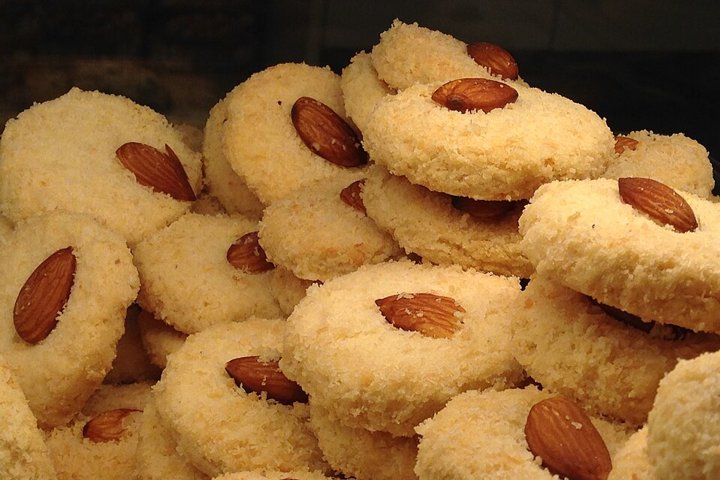
Ingredients
- 200 g ground almonds labelled “gluten free”
- 120 g sugar
- 1 large egg
- 1 teaspoon lemon zest and a pinch of salt
- Whole almonds to decorate (optional)
Method
- Preheat the oven to 180 °C and line a tray with baking paper.
- Mix the ground almonds, sugar, lemon zest and salt.
- Add the beaten egg and mix until you have a soft, sticky dough.
- With wet hands, shape walnut-sized balls, place them apart and flatten slightly. Top each with an almond if you like.
- Bake for 12 to 15 minutes, until the edges are golden.
- Let them cool for 10 minutes on the tray: they firm up as they cool.
Oat and banana cookie recipe
It is the quickest recipe: it has no added sugar, because the sweetness comes from the ripe banana. The riper it is, the sweeter they turn out. The texture is softer than a butter cookie.
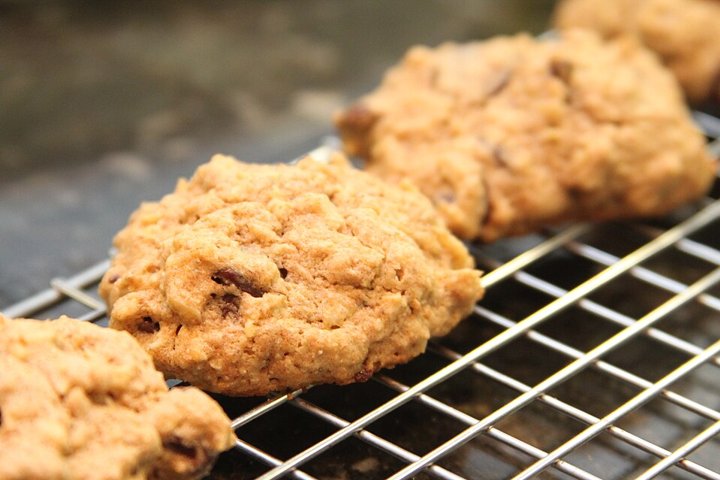
Ingredients
- 2 very ripe bananas (about 200 g, peeled)
- 120 g rolled oats certified gluten free
- A pinch of cinnamon (optional)
- 40 g chocolate labelled “gluten free”, in pieces (optional)
Method
- Preheat the oven to 180 °C and line a tray with baking paper.
- Mash the bananas with a fork into a purée.
- Add the oats, cinnamon and chocolate if using, and mix.
- Rest the dough for 5 minutes so the oats absorb the moisture.
- Spoon small mounds onto the tray, flatten them slightly and bake for 12 to 15 minutes.
- Let them cool on the tray before moving them.
Variant: chocolate chip cookies
For almond cookies, add 50 g of chocolate chips or chunks with the “gluten free” label to the dough before shaping the balls, and flatten them less. They come out softer than the plain almond ones. If you avoid lactose, check that the chocolate has no milk: the almond recipe, without it, has no butter or milk. In the oat and banana one, the chocolate is already optional.
Common mistakes and how to fix them
| Problem | Likely cause | What to do |
|---|---|---|
| They stick to the tray | No baking paper or a very wet dough | Use baking paper and let them cool before moving them. |
| They are too soft | Taken out of the oven too early | Bake a couple of minutes more, until the edges are golden. |
| Raw in the middle | Balls too thick or oven not hot enough | Flatten them more and check the oven temperature. |
| They break when moved | Moved while hot | Wait 10 minutes: they firm up as they cool. |
| The oat dough is very wet | Very large bananas | Add another spoonful of oats and rest for 5 minutes. |
These are general baking guidelines; we have not tested every oven or brand.
Baking at home without cross-contamination
If there is a celiac at home, FACE recommends removing wheat flour and breadcrumbs with gluten and using gluten free ones instead, so that what is cooked at home can be eaten by everyone. For cookies:
- Clean the worktop and bowls well before starting if you have used wheat flour.
- Use new baking paper and a clean tray.
- Store the cookies in their own container, without mixing them with others that contain gluten.
If you buy cookies
Look for the “gluten free” label on the pack. FACE warns that products labelled “very low gluten”, with between 20 and 100 ppm, are not valid for celiacs: “The only valid label for celiac people is GLUTEN FREE”. Do not buy loose cookies, which carry a higher risk of cross-contact. For more context, see the gluten free diet guide and gluten free desserts.
Frequently asked questions
What flour is used for gluten free cookies?
The recipes in this guide use no cereal flour: they use ground almonds or certified oats. For other cookies, rice flour with cornstarch or a gluten free baking flour is used, always with the “gluten free” label.
What ingredients should I check in cookies?
The ground almonds, the oats, any flour, the chocolate and any packaged extras. All must carry the “gluten free” label or have a checked ingredient list.
Are oat cookies gluten free?
Only if the oats are certified gluten free. Regular oats can be contaminated with wheat in the field and the mill.
Do these cookies contain lactose?
No: the almond recipe has no milk or butter, and neither does the oat and banana one. If you add chocolate, check that it has no milk.
How do I make gluten free chocolate chip cookies?
Add 50 g of chocolate with the “gluten free” label to the almond dough before shaping the balls, and bake a couple of minutes less if you want them soft.
Can they be made without egg?
We have not tested these recipes without egg. The oat and banana one has no egg; the almond one does.
How long do homemade cookies last?
Store them in a closed container once cold. We have not measured how long they last, so eat them soon and discard them if you notice an odd smell or texture.
Are “wheat free” cookies safe for celiacs?
Not necessarily. They may contain barley, rye or traces of gluten. Only the “gluten free” label counts.
Photo credits
Photos from Wikimedia Commons, illustrative of the dish: they do not guarantee the product shown is gluten free. Oat cookies on a cooling rack: Keith McDuffee, CC BY 2.0; Almond cookies with a whole almond on top: Triv.rao, CC BY-SA 4.0.
Approximate recipes; we have not tested variants with other flours. Sources: FACE advice and FACE food classification.