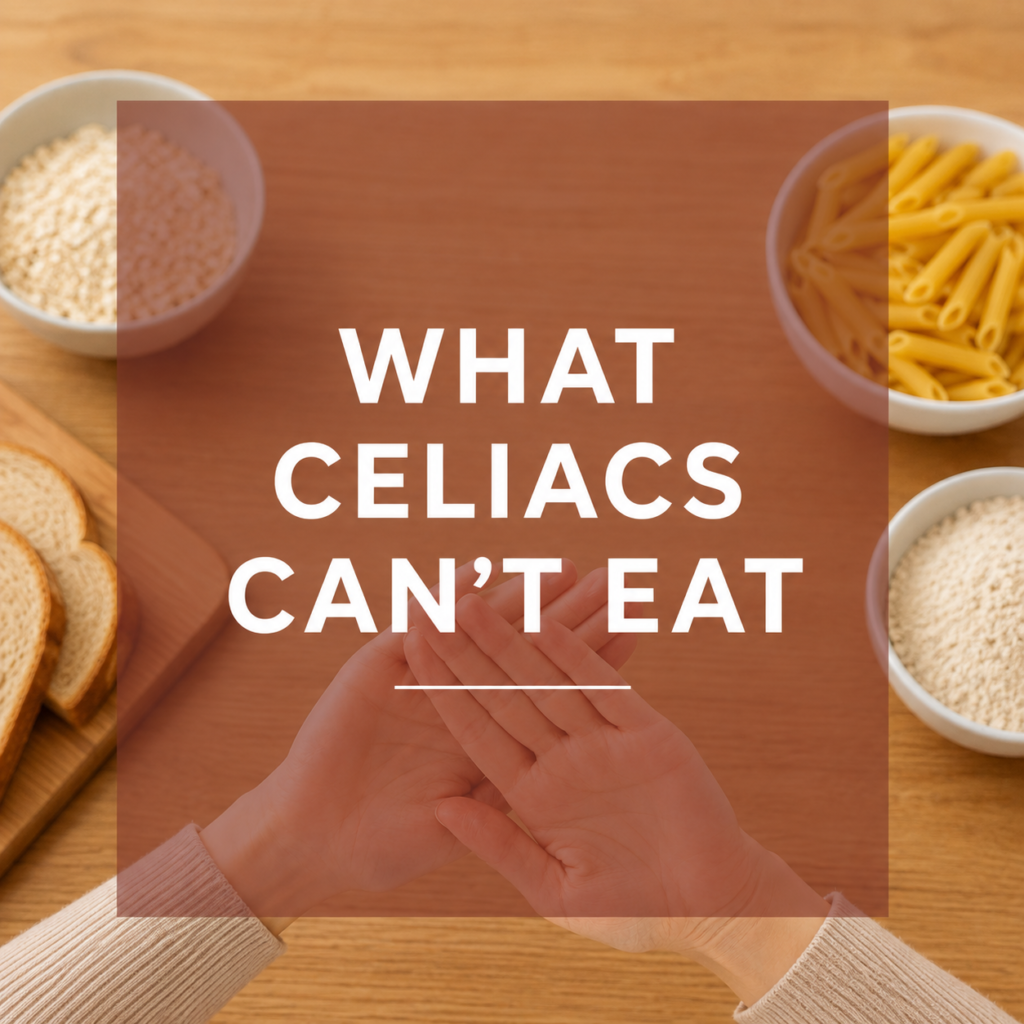
They’ve just told you you’re coeliac and the first thing you want is the list. What comes off the table from today.
Here it is, with the caveats that actually matter. Because some things you’ll never eat again, others depend on the label, and a fair few get dropped for no reason at all.
We’re writing this from a 100% gluten-free kitchen. Which is where you end up spotting the odd places gluten turns up.
What foods can’t coeliacs eat: the table
Three columns, because real life has three columns and not two.
| Off the menu | Check the label | Gluten-free by nature |
|---|---|---|
| Wheat bread, pasta and pastries | Cured and cooked meats | Vegetables |
| Wheat, barley and rye flour | Carton stocks and soups | Fresh fruit |
| Ordinary beer | Ready-made sauces and sofrito | Fresh meat and fish |
| Battered and breaded food | Seafood sticks | Eggs |
| Semolina, couscous and bulgur | Spreadable and processed cheese | Dried pulses |
| Spelt, kamut and einkorn | Food colourings and spice mixes | Rice, maize and quinoa |
| Triticale | Crisps | Milk, oil and sugar |
You’ll learn the first column in an afternoon. The third one is reassuring. And the middle one is what causes the trouble during your first year.
The cereals coeliacs can’t eat
There are five, and one of them comes with an asterisk.
A coeliac «must avoid any product listing wheat, barley, rye, triticale and probably oats among its ingredients».
FACE · Spanish Federation of Coeliac Associations
That «probably» next to oats isn’t sloppy writing. There’s a reason for it and I’ll get to it further down.
And watch out for the fancy names. Spelt, kamut and einkorn are wheat wearing a different label. They contain exactly the same gluten, even when they’re sold in the health food aisle at four times the price.
Triticale will be less familiar. It’s a wheat and rye hybrid used mostly in animal feed, though it shows up in the odd artisan loaf and in cereal blends.
From there down, anything made with those five: bread, pasta, semolina, couscous, bulgur, pastries, biscuits, batter, beer. Ordinary beer is made from barley, so it’s on the list even though it’s a drink.
Gluten to avoid in processed food
None of the products in the middle column contains gluten by nature. It gets added as a thickener, as a carrier for an additive, or it’s picked up in the factory.
«They need to be careful with processed, transformed or packaged foods, because once they’ve been handled, it’s harder to guarantee they’re gluten-free due to cross-contamination».
Translated into your Thursday shop: the more processed something is, the more times you need to turn the packet over.
The usual suspects are cooked ham, stock cubes, soy sauce, surimi and food colourings. None of them has to contain gluten. Plenty of them do.
Foods coeliacs can’t eat that don’t look the part
Three of them catch nearly everyone out in the first month.
Crisps. Potatoes don’t contain gluten, but ham or barbecue flavourings can, and some factories share a line with breaded products.
Soy sauce. The traditional recipe is fermented with wheat. The gluten-free version exists and it’s called tamari, though it’s worth checking that label too.
Surimi. Seafood sticks use starch as a binder, and in a good few brands that starch is wheat.
The list of foods coeliacs can’t eat barely changes from one year to the next. The list of specific products containing them changes every time a brand reformulates, which is why FACE publishes a list of approved foods and updates it every year.
Which vegetables can’t a coeliac eat?
None. Not a single one.
Every vegetable is gluten-free. So is fruit, meat, fish, eggs, pulses and unprocessed dairy.
Plenty of people search for this, and it makes sense: when you’re diagnosed you go into suspicion mode and start doubting everything in the fridge. It passes after a few weeks.
What a coeliac can’t eat is never the vegetable itself. It’s what’s been done to it before it reached the plate: the batter, the sauce, the stock in the soup, or the pan where a croquette was fried half an hour earlier.
The labelling trap: gluten-free and very low gluten
There are two labels that look almost identical and mean different things.
«Gluten-free» means under 20 mg per kilo. That product is safe for you.
«Very low gluten» means between 20 and 100 mg per kilo. That one isn’t suitable for coeliacs.
It’s set by Regulation (EU) 828/2014, in force since July 2016. Both products sit on the same shelf, in similar typefaces, sometimes under the same brand.
If you only take one sentence away from this whole article, take that one.
«Very low gluten» is made from wheat with almost all the gluten stripped out. Almost. It exists because other countries use it in transition diets, and on Spanish shelves it ends up right next to the safe one.
The seals that count and the one that disappeared
If you’ve been coeliac for years you’ll recognise the «Controlado por FACE» mark. It isn’t issued any more.
FACE withdrew it on 31 December 2019 and since January 2020 it uses the European Licensing System, the crossed grain symbol inside a circle. It’s the same symbol across Europe, which was the whole point.
One detail that tends to go unnoticed and that ruffled a few feathers at the time: the old mark required a maximum of 10 mg of gluten per kilo, and the European system allows up to 20.
Both sit below the legal threshold and both are safe. But if you were wondering why that seal vanished from the packet, that’s why.
Restaurants work differently. There there’s no single European seal, but schemes run by the coeliac association in each region.
In the Valencian Community that’s ACECOVA, which is part of FACE, with its Moments Sense Gluten programme. To get onto their list they review the premises, review the whole food offering and train every member of staff, and they publish the reviewed establishments in a list they update several times a year.
Every region has its equivalent. If you’re travelling, the local coeliac association usually has the list published, which beats trusting a sticker in a window.
Oats, the case that isn’t closed
Pure oats don’t contain gluten. That isn’t the problem.
The problem is that oats are grown in fields next to wheat, carried in the same lorries and milled in the same mills. Ordinary supermarket oats arrive contaminated nearly every time.
Certified gluten-free oats exist, and there the contamination risk disappears. Even so, some coeliacs react to clean oats because of a protein of their own called avenin, which is why FACE writes «probably» instead of calling the matter settled.
The sensible move if you’ve just started: leave them out for a few months and decide with your doctor, not with a blog.
The gluten that sneaks into your own kitchen
You can buy everything right and still get glutened at home. It happens more than you’d think, especially when the same kitchen cooks with gluten and without it.
FACE’s recommendations here are fairly specific:
- The toaster. Keep one for gluten-free only. It’s one of the hardest appliances to clean inside.
- The colander. Also dedicated, for the same reason. A pasta colander holds crumbs you can’t see.
- Wood. Best avoided. A wooden board is porous and, however well you wash it, it keeps gluten inside. FACE recommends switching to silicone.
- Frying oil. If anything with gluten has been fried in that oil, it’s finished. And straining it does nothing, because gluten doesn’t break down at high temperatures.
The oil is the one most people skip, and it’s the clearest of the lot. A shared fryer always contaminates.
The home trick that works best is colour coding: one colour of utensils for gluten-free and another for everything else. That way you’re not relying on your memory at nine at night.
Medicines contain gluten too
This one gets past almost everybody, and it’s easier to sort out than it sounds.
Some medicines use starch as an excipient. Maize, potato or rice starch doesn’t affect a coeliac. Wheat starch can.
The good news is that it’s regulated in Spain. Since 2008 it’s been compulsory for a medicine to declare whether it contains starch, where that starch comes from and how much gluten it holds. And it has to appear on the box, in the leaflet and in the technical data sheet.
The AEMPS, the Spanish medicines agency, published a document on this with FACE in 2018, and its CIMA search tool lets you check it medicine by medicine.
If you’re standing in a pharmacy unsure, the exact question is whether the excipient contains wheat starch.
What no label can tell you
You’ll have the list above nailed in a fortnight. In your own kitchen you’re in charge, you read the packets and you decide what comes in.
Away from home it gets harder. At a table that isn’t yours you can’t see the stock carton, or which oil the potatoes were fried in, or whether the grill has spent half an hour sharing space with a sandwich.
That’s why 100% gluten-free kitchens exist. At our gluten-free restaurant in Valencia there’s no second menu: wheat flour doesn’t come through the kitchen door, so the whole table above stops applying.
You can point at any line on the menu and order it without asking what’s in it. Which is exactly what stops being possible the moment you eat out.
Frecuently questions
What foods can't coeliacs eat?
Anything containing wheat, barley, rye or triticale, plus oats unless they’re certified. That covers bread, pasta, pastries, semolina, couscous, ordinary beer and any standard batter. Spelt and kamut too, because they’re wheat.
Which foods are off-limits for coeliacs?
The ones containing wheat, barley, rye or triticale. A coeliac can’t eat bread, pasta, pastries, semolina or ordinary beer, and standard batter is out too. Oats stay off the list unless they come certified gluten-free.
Can a coeliac eat chips?
Potatoes are gluten-free. The risk is in the fryer: if croquettes or battered food have been fried in that oil, the chips come out contaminated, and straining the oil doesn’t fix it. At home you can control it. Eating out, you have to ask.
Is alcohol-free beer safe for coeliacs?
Not just because it’s alcohol-free. Beer is made from barley, so it contains gluten unless the label says «gluten-free». There are 0.0 beers with gluten and 0.0 beers without, and they’re different products.
Can medicines contain gluten?
Yes, when they use wheat starch as an excipient. In Spain it’s been compulsory to declare it on the box and in the patient leaflet since 2008. The AEMPS CIMA search tool lets you check before you buy anything.